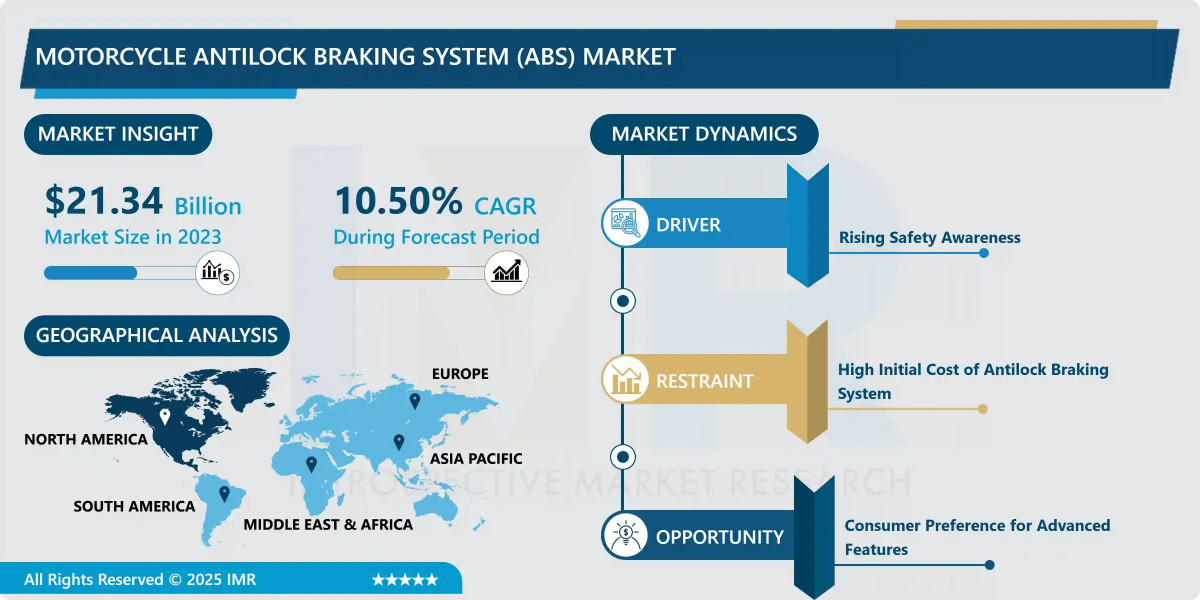

According to a new report published by Introspective Market Research, Motorcycle Antilock Braking System (ABS) Market by Motorcycle Type, Sales Channel, Technology, and Region, The Global Motorcycle Antilock Braking System Market Size Was Valued at USD 21.34 Billion in 2023 and is Projected to Reach USD 52.41 Billion by 2032, Growing at a CAGR of 10.5%.
Market Overview:
The global Motorcycle Antilock Braking System (ABS) market consists of advanced safety systems designed to prevent wheel lock-up during emergency braking, thereby maintaining traction and allowing the rider to steer. Modern ABS units utilize electronic sensors, a control unit, and hydraulic modulators to monitor wheel speed and automatically modulate brake pressure. The critical advantage over conventional braking systems is the prevention of skidding and loss of control, which significantly reduces the risk of single-vehicle crashes and collisions, particularly on slippery or uneven surfaces.
This safety technology is becoming increasingly standard across all segments of the two-wheeler industry, from entry-level commuter motorcycles to high-performance sports bikes and premium cruisers. Its primary use is to enhance rider safety, which is a paramount concern for consumers, regulators, and manufacturers alike. The market's robust growth is propelled by stringent government safety regulations mandating ABS on new motorcycles in key regions like Europe, India, and others. Furthermore, growing rider awareness about safety features, increasing insurance premium discounts for ABS-equipped bikes, and the rising premiumization of the global motorcycle market are accelerating adoption, transforming ABS from a luxury option to an essential safety standard.
Growth Driver:
The paramount growth driver for the motorcycle ABS market is the increasingly stringent global regulatory framework mandating ABS installation on new motorcycles for enhanced rider safety. Governments and transportation authorities worldwide are implementing and tightening regulations to reduce motorcycle-related fatalities and injuries. For instance, the European Union has mandated ABS for all new motorcycles above 125cc since 2016, and India has made ABS compulsory for all two-wheelers above 150cc. These regulations create a non-negotiable compliance requirement for manufacturers, ensuring that ABS becomes a standard feature across a vast portion of new motorcycle production. This top-down regulatory push is the most powerful and consistent force driving market volume and penetration rates globally.
Market Opportunity:
A significant market opportunity lies in the penetration of cost-optimized, single-channel ABS systems into the high-volume, price-sensitive commuter and entry-level motorcycle segments in emerging economies. While multi-channel ABS is common in premium bikes, the vast majority of motorcycles sold globally are small-engine commuter models in Asia-Pacific and Latin America. Developing and manufacturing reliable, compact, and affordable single-channel ABS (typically for the front wheel only) tailored for these markets presents a massive growth frontier. Additionally, the growing aftermarket retrofit segment offers substantial potential, as existing owners of non-ABS motorcycles seek to upgrade their bikes for safety, creating a secondary market for ABS kits and installation services.
Motorcycle Antilock Braking System Market, Segmentation
The Motorcycle Antilock Braking System Market is segmented on the basis of Motorcycle Type, Sales Channel, and Technology.
Sales Channel
The Sales Channel segment is further classified into OEM (Original Equipment Manufacturer) and Aftermarket. Among these, the OEM sub-segment accounted for the highest market share in 2023. The OEM channel's dominance is absolute, driven directly by the regulatory mandates that require manufacturers to install ABS on new motorcycles during production. As regulations expand to cover more motorcycle categories and regions, the OEM integration of ABS becomes the default, accounting for the overwhelming majority of system sales. This channel benefits from economies of scale, integrated vehicle design, and the primary push from safety compliance.
Motorcycle Type
The Motorcycle Type segment is further classified into Standard, Sports, Cruiser, Touring, and Others. Among these, the Sports motorcycle sub-segment accounted for the highest market share in 2023. Sports motorcycles are typically high-performance machines where braking power and safety are critical. Riders and manufacturers of this segment were early adopters of advanced ABS, including sophisticated multi-channel systems with lean-angle sensitivity (Cornering ABS). The high value of these motorcycles allows for the integration of premium safety technology, and the performance-oriented consumer base demands the highest levels of safety and control, making this segment a key revenue driver.
Some of The Leading/Active Market Players Are-
• Robert Bosch GmbH (Germany)
• Continental AG (Germany)
• ZF Friedrichshafen AG (Germany)
• Brembo S.p.A. (Italy)
• BWI Group (China)
• Hitachi Astemo, Ltd. (Japan)
• ADVICS Co., Ltd. (Japan)
• Nissin Kogyo Co., Ltd. (Japan)
• Honda Motor Co., Ltd. (Japan)
• BMW Motorrad (Germany)
• Melrose Industries plc (UK)
• WABCO Holdings Inc. (Belgium)
• Aisin Seiki Co., Ltd. (Japan)
• Autoliv Inc. (Sweden)
• Haldex AB (Sweden)
• and other active players.
Key Industry Developments
News 1:
In February 2024, Bosch launched its next-generation Motorcycle Stability Control (MSC) unit with an integrated, lighter ABS system featuring a new pressure sensor for even more precise brake modulation. This system offers improved performance for adventure and touring bikes, particularly in off-road and cornering scenarios, enhancing safety for premium segments.
News 2:
In December 2023, Continental AG announced a breakthrough in developing a more compact and cost-effective single-channel ABS specifically designed for high-volume, small-displacement motorcycles in emerging markets. This aims to help manufacturers meet upcoming regional safety regulations without significantly increasing the final cost of entry-level models.
Key Findings of the Study
• The OEM sales channel dominates overwhelmingly due to direct regulatory mandates for new motorcycle production.
• Asia-Pacific is the fastest-growing regional market, fueled by regulations in India and ASEAN countries and massive production volumes.
• Government safety regulations mandating ABS are the primary and most powerful growth driver.
• Key trends include the development of lightweight, affordable systems for emerging markets and the evolution of cornering ABS and connected safety systems for premium motorcycles.